
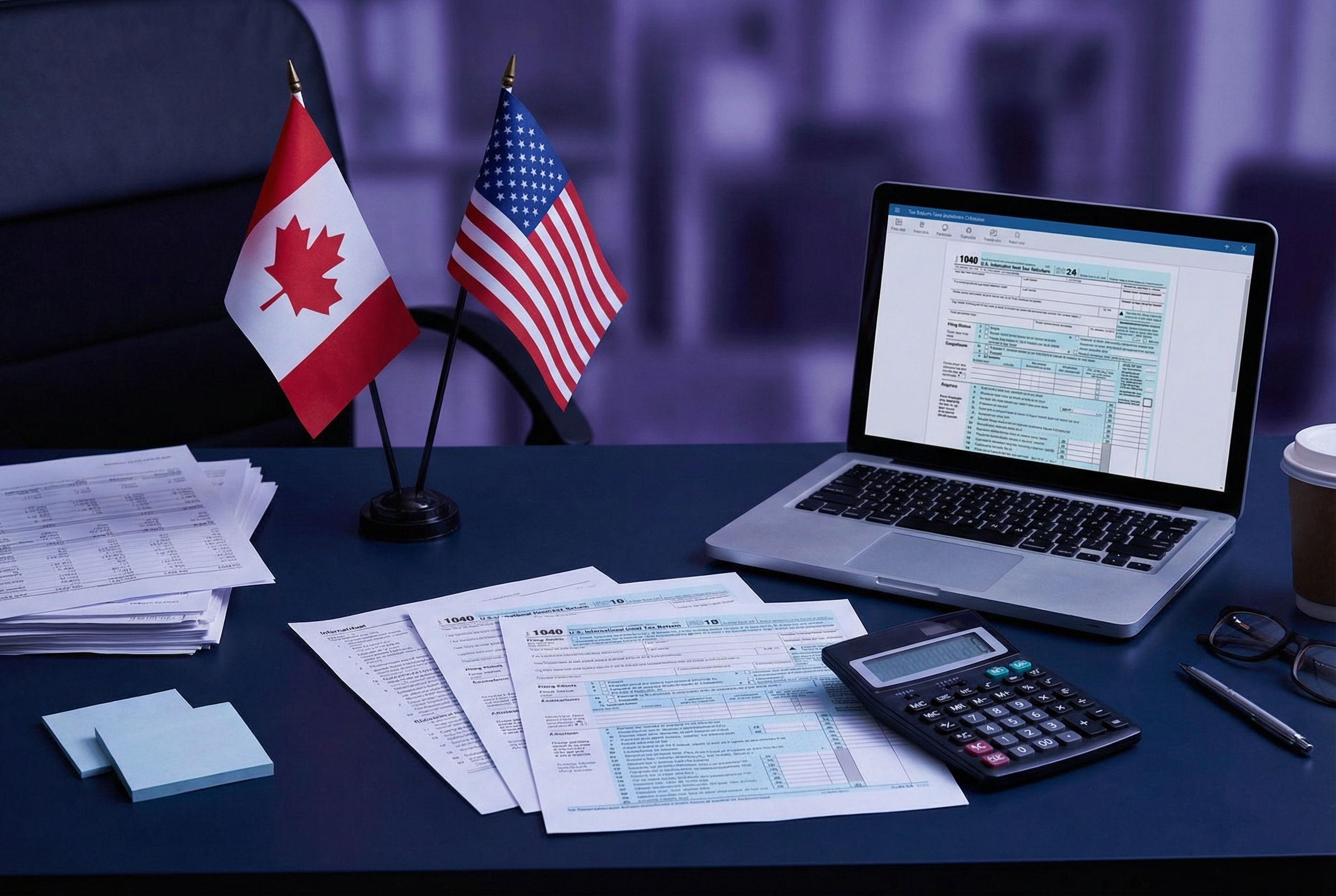
Foreign reporting obligations are information returns, not tax returns; they carry no tax but very large penalties. Missing an FBAR or T1135 can cost more than the underlying account balance. This guide walks through each major form, the thresholds, the penalties, and the cleanup programs for prior-year misses.
FBAR (FinCEN 114): The Foundation of U.S. Foreign Reporting
U.S. persons with a financial interest in or signature authority over foreign financial accounts with an aggregate value exceeding $10,000 at any point during the calendar year must file FinCEN Form 114 (FBAR) by April 15, with an automatic extension to October 15.
The $10,000 threshold is aggregate across all foreign accounts, not per account. A Canadian with $6,000 in a TD account and $5,000 in an RBC account is over the threshold even though no single account exceeds $10,000. The test is also highest balance during the year, not year-end balance.
Form 8938 (FATCA): Similar, But Different Thresholds and Scope
Form 8938 is filed with the U.S. income tax return by U.S. persons with specified foreign financial assets exceeding threshold amounts that vary by filing status and residence (ranges from $50,000 for single U.S. filers up to $600,000 for married-filing-jointly foreign residents).
Form 8938 includes more than just accounts; it covers foreign stock, foreign partnership interests, foreign mutual funds (PFICs), and certain foreign retirement plans. Many taxpayers who file FBAR also need Form 8938, but the two forms have different thresholds and categories.
Canadian T1135: Foreign Income Verification Statement
Canadian residents who owned specified foreign property with a total cost base exceeding CAD 100,000 at any time during the year must file T1135 with their T1. Specified foreign property includes foreign bank accounts, foreign stock (unless held in a Canadian brokerage), foreign real estate held as investment, and certain other foreign holdings.
Personal-use foreign real estate (a vacation home used primarily for personal enjoyment) is generally excluded. Foreign real estate held for investment is included. The distinction matters and should be documented.
Penalties That Dwarf the Tax
FBAR non-willful penalties up to $10,000 per account per year (inflation-adjusted). Willful penalties up to the greater of $100,000 or 50% of the account balance, per account per year. These penalties can exceed the underlying account balance.
Form 8938 penalties start at $10,000 per year with escalation. T1135 penalties start at CAD 2,500 for first missed year and escalate to CAD 12,000 for continuing gross negligence. These are information-return penalties assessed regardless of underlying tax owed.
Who Is 'Willful' for FBAR Purposes
FBAR willfulness covers actual knowledge, reckless disregard, and willful blindness. A taxpayer who 'knew or should have known' about the filing obligation can be treated as willful. This is a factual determination, and case law (Kimble, Bedrosian, Williams, and others) has expanded the government's ability to assert willfulness.
Anyone who signed a U.S. tax return answering Schedule B Part III or a similar question incorrectly has increased willfulness exposure. Correcting before the IRS notices is usually cheaper than arguing willfulness later.
Streamlined Procedures for Past Non-Compliance
The IRS Streamlined Filing Compliance Procedures cover non-willful past non-compliance with foreign reporting. Streamlined Domestic Offshore Procedures (SDOP) apply to U.S. residents and require a 5% miscellaneous offshore penalty on the highest aggregate balance. Streamlined Foreign Offshore Procedures (SFOP) apply to eligible U.S. persons residing outside the U.S. and waive the miscellaneous penalty.
Eligibility requires a non-willful certification and the filing of three years of amended returns and six years of FBARs. We run the eligibility analysis and prepare the package for submission.
CRA Voluntary Disclosure Program (VDP)
The Canadian VDP offers two tracks: General Program (interest and penalties are waived, partial interest relief for some older years) and Limited Program (only penalty relief, no interest relief) for more serious non-compliance. Eligibility requires voluntary disclosure before any CRA contact, a complete disclosure, information more than one year past due, and tax owing.
T1135 non-compliance is a common VDP application. The program has specific procedural requirements and time limits.
Crypto and Foreign Exchanges
Cryptocurrency held on foreign exchanges raises complex reporting questions. FinCEN's position on foreign crypto exchange reporting has evolved; the IRS has indicated that foreign crypto wallets and exchanges are likely FBAR-reportable once rules are finalized. Form 8938 reporting for foreign crypto is clearer.
Canadian crypto held on foreign exchanges (Binance, Kraken outside Canada) is T1135-reportable where the cost exceeds CAD 100,000. Crypto held in a Canadian exchange (Wealthsimple Crypto, Shakepay, NDAX) is generally not T1135-reportable because the exchange is Canadian.
Building a Foreign Reporting Checklist Into Year-End
Our year-end client questionnaire includes specific questions about foreign accounts, foreign real estate, foreign retirement plans, and crypto held on foreign platforms. Capturing this annually prevents the slow drift from compliant to non-compliant that happens when a client opens one new foreign account without mentioning it.
How TYM Engagement Works in Practice
Every engagement begins with a scoping call to map your structure, jurisdictions, filing history, and immediate pressure points. We then deliver a written roadmap: which entities file where, which deadlines apply in the next 12 months, and which decisions (entity choice, residency, compensation mix, inventory location) carry the largest tax impact.
Execution runs on a shared workpaper platform so your team sees status, open items, and deliverables in real time. We assign a lead partner, a cross-border tax specialist, and a staff accountant to every file. The lead partner signs returns, reviews positions, and is the single point of escalation.
Clients typically engage us annually for compliance plus three or four planning touchpoints through the year: quarterly estimates, mid-year review, year-end tax planning, and post-filing debrief. This rhythm prevents surprises and captures planning opportunities while they are still actionable.
Why Clients Choose a Cross-Border CPA Firm
Generalist firms often handle either U.S. or Canadian tax but not both. When a U.S. shareholder opens a Canadian subsidiary or a Canadian founder relocates to Miami, the return preparer on one side assumes the other side is correct. Mismatches surface years later as penalties, double taxation, or lost treaty benefits.
TYM Consulting was built for clients who need both sides handled under one engagement. Our Toronto and Miami teams file the T1, T2, and GST/HST returns plus the 1040, 1120, and state returns in coordination, with transfer pricing, treaty positions, and foreign tax credits matched across both jurisdictions.
The investment in a coordinated approach typically pays for itself in the first year through avoided penalties, optimized withholding, and better credit utilization. In subsequent years the benefit compounds as structure and compensation decisions align with long-term goals.
Do I file both FBAR and Form 8938?
Often yes. They cover overlapping but not identical ground, and filing one does not satisfy the other.
What if I have never filed an FBAR?
Streamlined Procedures are the most common remedy for non-willful past non-compliance. Act before the IRS contacts you.
Does T1135 apply to U.S. mutual funds in my TD account?
Securities held in a Canadian brokerage are generally exempt from T1135 reporting.
Is my U.S. 401(k) reportable on T1135 after I move to Canada?
Generally yes. Foreign retirement accounts held by Canadian residents are T1135-reportable above the threshold.